

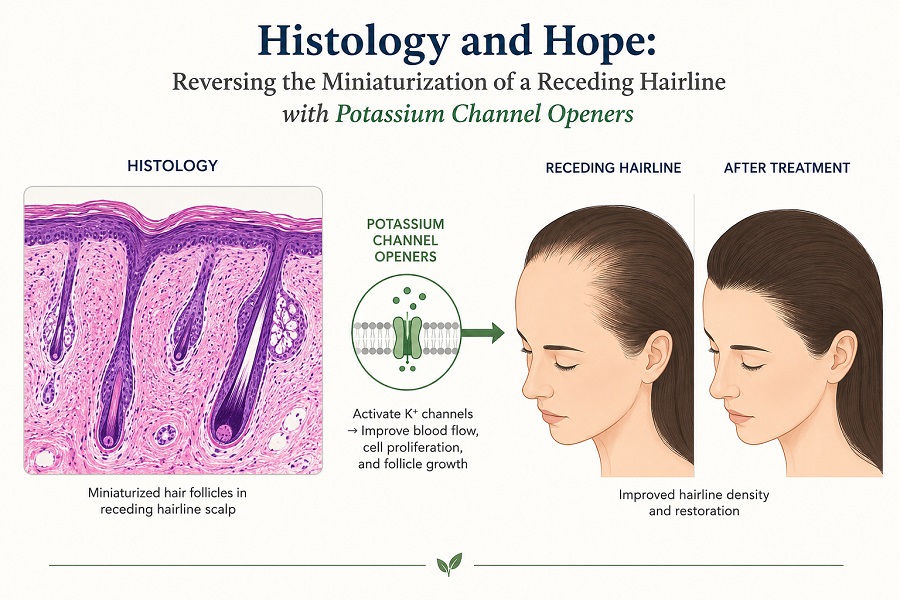
In the clinical landscape of 2026, the management of a receding hairline has transitioned from a battle against the inevitable to a sophisticated application of follicular biology. For decades, the medical community largely categorized frontal hair loss as a permanent structural change. However, contemporary advancements in histology—the study of the microscopic structure of tissues—have revealed that many follicles in a receding hairline are not dead, but are simply trapped in a state of extreme miniaturization.
The primary mechanism for rescuing these follicles involves the use of potassium channel openers. By understanding how minoxidil interacts with the cellular architecture of the frontal scalp, patients can move beyond temporary concealment and toward genuine biological restoration.
The Histology of the Frontal Fringe
The human scalp is not a uniform environment. The follicles located at the hairline and temples are biologically distinct from those at the vertex (the crown). Research indicates that frontal follicles often have a higher density of androgen receptors. This makes them particularly sensitive to Dihydrotestosterone (DHT), the hormone responsible for androgenetic alopecia.
When DHT binds to these receptors, it initiates a process known as miniaturization. Under a microscope, a healthy hair follicle looks like a deep, robust “bulb” rooted in the subcutaneous fat. As miniaturization progresses, the follicle physically shrinks and moves closer to the surface of the skin. The diameter of the hair shaft decreases, and the anagen (growth) phase of the hair cycle shortens.
The challenge of a receding hairline is that these follicles eventually reach a state of “vellus” production—producing fine, colorless hairs that are barely visible to the naked eye. However, as long as the follicle has not reached the stage of fibrosis (the replacement of the follicle with scar tissue), the potential for reversal remains.
Potassium Channel Openers: The Cellular Signal
The introduction of minoxidil to the scalp serves a purpose far greater than simple blood flow stimulation. At the molecular level, this treatment belongs to a class of drugs known as potassium channel openers. To understand why this is critical for a receding hairline, we must look at the electrical potential of the follicular cells.
Hyperpolarization and Survival
When a potassium channel opener is applied to the scalp, it targets the ATP-sensitive potassium channels in the cell membranes of the dermal papilla. By opening these channels, potassium ions flow out of the cell, leading to a state called hyperpolarization. This electrical shift “relaxes” the follicle and prevents it from entering the resting (telogen) phase prematurely.
Overriding the Genetic “Retreat”
For someone experiencing a receding hairline, the genetic signal is telling the follicle to shrink and eventually shut down. The application of a potassium channel opener provides a counter-signal. By hyperpolarizing the cell, the treatment effectively overrides the androgen-driven signal to miniaturize. This keeps the follicle in the anagen phase for longer durations, allowing the hair bulb to grow larger and produce a thicker hair shaft over time.
The Importance of Angiogenesis in Frontal Restoration
One of the secondary benefits of using minoxidil is the induction of angiogenesis—the formation of new blood vessels. A shrinking follicle is often a starving follicle. As the hair bulb diminishes, the capillary network that feeds it also regresses.
The frontal scalp naturally has a lower baseline of blood flow compared to the back of the head. When a receding hairline begins to form, the reduction in nutrient delivery accelerates the loss. By inducing vasodilation, the treatment re-establishes the “nutrient highway.” This surge of oxygen and blood-borne nutrients provides the raw materials necessary for keratinocytes (hair-producing cells) to build a terminal hair shaft.
The Window of Viability: Why Timing Matters
In 2026, trichologists emphasize the “Window of Viability.” Because a receding hairline involves the slow degradation of the follicular unit, there is a period where the damage is reversible.
Once the scalp becomes smooth and shiny, it suggests that the follicle has undergone fibrosis. In this state, the follicular pore has closed, and the living tissue has been replaced by collagenous scar tissue. Potassium channel openers cannot revive a fibrotic follicle. However, if the area still has “peach fuzz” or fine vellus hair, the histology suggests the follicle is still alive and capable of responding to clinical stimulation. This is why early intervention is the cornerstone of modern hair restoration.
Optimizing the Application for the Frontal Scalp
Because the skin on the forehead and temples is thinner and has different sebaceous (oil) gland density than the rest of the scalp, the delivery method of minoxidil is crucial.
1. The Superiority of Foam in Frontal Areas
For many men, foam formulations have become the preferred standard for treating a receding hairline. Unlike liquid solutions, which can run down the forehead and cause irritation or unwanted hair growth near the eyebrows, foam stays localized. It absorbs quickly into the targeted area, ensuring the active ingredient reaches the dermal papilla of the frontal follicles without unnecessary waste.
2. Scalp Preparation
To ensure the potassium channel opener can penetrate the skin barrier, the scalp must be free of mineral buildup and excess sebum. In urban environments, pollutants can create a “film” on the skin that hinders absorption. Regular cleansing ensures that the medication reaches the depth of the follicle where the SULT1A1 enzymes can convert the drug into its active sulfate form.
What Success Looks Like: The Terminal Conversion
Reversing a receding hairline is a game of millimeters and months. It is important to have realistic expectations based on the hair growth cycle.
- Months 1–3 (The Reset): You may experience a temporary shed. This is actually a positive sign; it indicates that the potassium channel opener is forcing “resting” follicles into the “growth” phase, pushing out old, thin hairs to make way for new ones.
- Months 4–8 (The Transition): The fine vellus hairs at the hairline begin to gain pigment and diameter. This is the “terminal conversion” phase.
- Months 9–12 (The Maturation): The new hair gains enough structural integrity to be styled. At this point, the baseline of the receding hairline has often stabilized or moved forward.
Conclusion: Science-Backed Hope for the Hairline
The management of a receding hairline has evolved from guesswork to a precise science. By utilizing minoxidil as a potassium channel opener, we are doing more than just encouraging hair to grow; we are intervening in the microscopic process of miniaturization.
The histological evidence from 2026 proves that the frontal scalp is not a “lost cause,” provided the treatment is started before permanent scarring occurs. By focusing on the cellular health of the follicle and maintaining the vascular network of the scalp, it is possible to hold the line against androgenetic alopecia. The key to reclaiming a hairline is a commitment to the biological process: providing the follicles with the signal and the sustenance they need to remain in the growth phase for years to come.
