

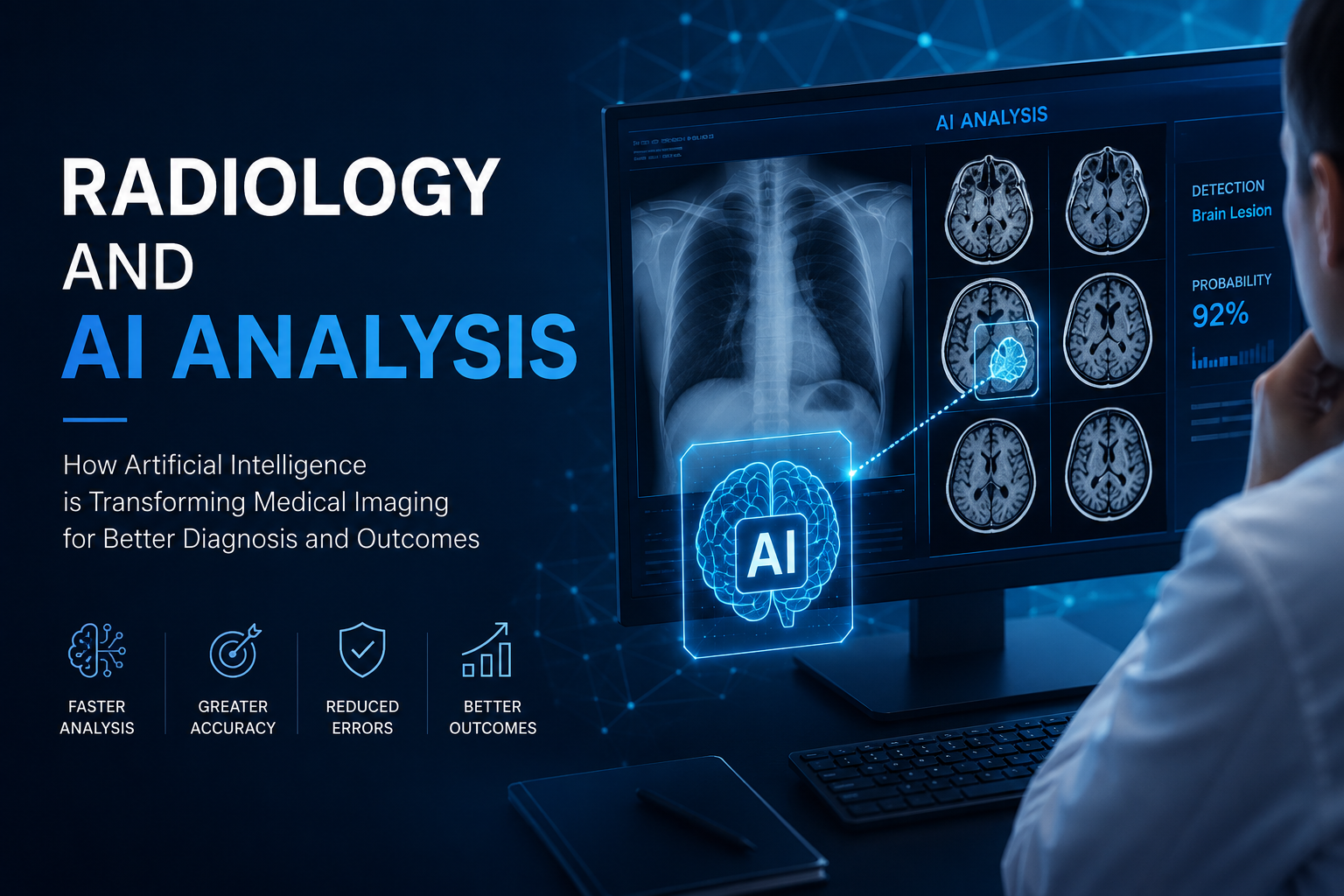
There is a particular kind of waiting that anyone who has had an MRI will recognise. The scan is done. The report exists — you may even be holding it. And somewhere between the moment it lands in your hands and the appointment where someone explains it, there is a gap. Sometimes that gap is a week. Often it is longer.
What fills that gap, for most people, is a search engine at two in the morning and a rising sense of alarm.
It is a reasonable question, then, whether the AI tools that have become part of ordinary life can help. The honest answer in 2026 is: yes, for one specific job, and much less than the marketing suggests for another. The difference between those two jobs is worth understanding before you type a word of your report into anything.
What does an MRI report actually say — and why can’t you read it?
A radiology report is not written badly. It is written for someone else.
The radiologist reading your scan is writing to the doctor who ordered it. Both share a vocabulary, and that vocabulary is doing real work: compressing a great deal of visual information into language precise enough that a colleague can act on it. T2-hyperintense focus, no acute intracranial abnormality, mild posterior disc protrusion at L5–S1 without significant canal stenosis — each phrase is efficient and exact for its intended reader.
You are not its intended reader. You are reading someone else’s professional correspondence about your own body, which is a strange position to be in. The anxiety that follows is not a failure of intelligence on your part. It is a failure of translation.
Most reports follow the same skeleton, which helps once you know it: Clinical history (why the scan was ordered), Technique (how it was done), Findings (everything the radiologist saw, including a great deal that is entirely normal), and Impression — the summary. If you read only one section, read the impression. It is where the radiologist says what they actually think.
Can AI explain an MRI report in plain language?
Yes. This is the thing it is genuinely good at, and it is the use worth reaching for first.
Since 2023 there has been a steady stream of research testing whether large language models can rewrite radiology reports at a reading level patients can follow. The consistent finding is that they can, and that the results are usually accurate enough to be useful — with the equally consistent caveat that they occasionally introduce errors, and that this should never be the only explanation a patient receives.
A model that turns there is no evidence of acute infarct into “no sign of a recent stroke” has not diagnosed anything. It has removed a barrier that should not have been there for you in the first place.
Can ChatGPT read my MRI scan?
This is a different question from the one above, and it is where most of the confusion lives.
A general chatbot can look at a picture you paste into it, and it will say something about that picture. What it is working with, however, is worth knowing.
An MRI is not one image. It is a stack of slices through your body — often several stacks, each acquired with different settings that make different tissues bright or dark. A T1 and a T2 image of the same anatomy look almost inverted: fluid is dark on one and bright on the other. A tool that does not know which sequence it is looking at can describe what it sees perfectly and still have the meaning exactly backwards.
When you paste one screenshot into a chatbot, that is its situation. It cannot scroll the volume. It cannot cross-check the other sequences. It has to guess the sequence from brightness, and it has no access to the geometric information stored in the scan file that records which way round you were lying — which is why general chatbots confuse a patient’s left and right on medical images more often than you would expect.
It will still answer, fluently and at length.
Fluency is not knowledge. That gap is the single most important thing to understand about using a chatbot for this.
What changed by 2026?
Three things, and the third matters most.
General models can genuinely see. The assistants most people use can now process images properly rather than approximately.
Specialised medical imaging models exist. Google’s MedGemma is the best-known — trained on medical images rather than on the internet at large, and available to developers rather than through any consumer chat window. Purpose-built tools can use models like this; a chatbot cannot reach them.
Tools can now open the real scan file. Not a photograph of a screen, but the actual DICOM or NIfTI study from the disc your hospital gave you. That means reading the sequence type from the file’s own metadata and the orientation from its stored geometry, instead of inferring either from appearances. It is an unglamorous distinction, and it is what separates a plausible answer from a grounded one.
(Disclosure: I work on one of these tools, Read Your Scan, so weigh my enthusiasm for that distinction accordingly. The underlying point holds whichever tool you use.)
Can AI give me a second opinion on my MRI?
Not in the sense that phrase usually means. A second opinion is a second qualified professional accepting responsibility for an interpretation. No AI system does that, and any service implying otherwise is overselling.
What an independent AI reading can honestly offer is narrower and still useful: a check on whether anything in the images was described differently, or not described at all, by a reader that has not seen your radiologist’s report and therefore cannot be anchored by it. That produces questions to raise, not a verdict to act on.
If you have genuine doubts about a report — because your symptoms do not match it, or a finding is being dismissed and you are not convinced — the answer is a formal second read by another radiologist, which most health systems will arrange on request. An AI reading is a way to work out whether to ask for that, not a substitute for it.
Five things AI still cannot do
This is the part most articles on this subject leave out, and it is the part that will actually protect you.
- It has not seen your previous scans. Much of what a radiologist knows comes from comparison. A finding stable for four years and the identical finding appearing for the first time mean completely different things. AI looking at today’s images alone cannot tell you which you have.
- It has not examined you. Your doctor has your history, your medications, your family background, and the results of putting hands on you. AI has the images and whatever you thought to type.
- A finding is not a symptom. This is the most important sentence here. A landmark review of imaging in people with no back pain at all found disc degeneration in roughly 37% of asymptomatic 20-year-olds, rising to about 96% by age 80. Disc bulges, meniscal wear and small joint changes are, for most adults, simply what a body that has been used looks like. Finding one does not establish that it is causing your pain.
- It can be wrong with total confidence. These systems do not signal uncertainty the way a person does. A fabricated finding and a correct one arrive in the same calm, authoritative register.
- No one has signed it. A radiologist’s report carries professional accountability. An AI explanation carries none. It is information, not a medical opinion, and it is not a diagnosis.
How do I open the MRI CD from the hospital on my own computer?
A practical obstacle worth solving, because most people never see their own images at all.
Hospital discs and USB sticks hold DICOM files — the medical imaging standard — usually in a folder structure with no obvious file extensions. The viewer software bundled on the disc is typically Windows-only, frequently ancient, and sometimes refuses to run at all.
You do not need it. Several free browser-based DICOM viewers will open the folder directly, and the good ones process the files on your own machine without uploading anything. Look for one that says so explicitly. Then simply drag the whole folder in — you do not need to work out which of the files matters.
Being able to see your own images while reading the report is more useful than either on its own.
How to use these tools well
If you are going to do this — and many people reasonably will — a few habits make it far more useful and much less frightening.
- Start with the report, not the images. Translating text is the task these tools do best, and it resolves most of the confusion.
- If you want the images read, use something that opens the real study, not a photograph of a screen.
- Protect your identity. Scan files carry your name, date of birth and hospital ID in their metadata. A reputable tool strips these before anything leaves your device.
- Treat what you get back as questions, not answers. The genuine value is walking into your appointment able to ask: “The report mentions a disc protrusion at L5–S1 — is that likely to be causing my symptoms, or is it incidental?” That is a better ten minutes than either of you would otherwise have had.
- If something alarms you, phone the clinic. Do not wait for the appointment. The one thing worse than not understanding your report is quietly deciding, alone, that it means the worst.
Frequently asked questions
Is it safe to upload my MRI to an AI tool?
It depends entirely on the tool. Scan files contain identifying information in their metadata, so use one that removes it before upload and says plainly what it stores. Tools that process images in your browser never transmit them at all.
Can AI diagnose what is wrong with me from an MRI?
No. It can describe what is visible and explain the terminology. Diagnosis means combining imaging with your history, examination and often further tests — and taking responsibility for the conclusion. That is a clinician’s job.
How accurate is AI at reading an MRI?
It varies enormously by task. Explaining report language is reliable. Detecting findings in images is genuinely useful but imperfect, and performance depends heavily on whether the tool reads the full study or a single image. Treat any specific accuracy claim with suspicion unless it names what was measured and against what.
Will my doctor mind that I used AI?
Most will not mind at all if you arrive with better questions. What tends to frustrate clinicians is a patient arriving with conclusions from an unnamed source. “I read that this finding is common — is that true in my case?” lands very differently from “the internet says I need surgery.”
How long do MRI results normally take?
Usually a few days to two weeks, depending on the health system and urgency. A long wait most often reflects low clinical priority rather than bad news — a genuinely worrying finding tends to prompt a phone call, not a longer wait.
The bottom line
In 2026, AI can reliably tell you what the words in your radiology report mean. That is a real service, and for most people it is enough.
It can also read the images, and the better tools do so with far more rigour than a chatbot handed a screenshot — but with no history, no comparison, no examination and no accountability. That makes it a way to arrive at your appointment better prepared. It does not make it a second doctor, and any tool suggesting otherwise is selling you something.
The gap between the scan and the appointment is a real problem, and it deserves a better answer than a search engine at two in the morning. AI is a good answer to that problem. It is not an answer to the question of what is wrong with you. Only your doctor can give you that.
This article is for general information. It is not medical advice, a diagnosis, or a substitute for your doctor or radiologist. If you have urgent symptoms, seek care.
