

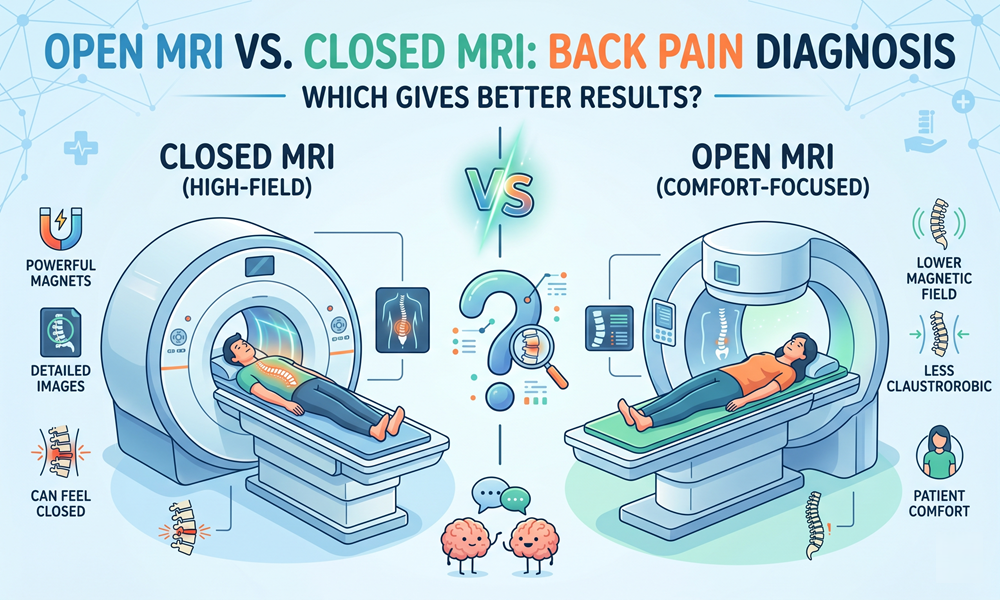
Back pain is one of the most common reasons patients are referred for MRI imaging. It is also one of the conditions where the choice between open and closed MRI is most clinically relevant. The spine is a dynamic structure. It responds to gravity, to movement, and to the load placed on it by the patient’s own body weight. How and where that structure is imaged can directly affect what the scan reveals and, by extension, what treatment decisions follow.
For patients navigating this choice, or asking their doctor which type of scan is appropriate, understanding the actual clinical differences between open and closed MRI for spinal conditions is more useful than a general comparison of the two technologies.
What Closed MRI Does Well for the Spine
High-field closed MRI systems, typically operating at 1.5 Tesla or 3 Tesla field strength, produce images with excellent contrast resolution and fine anatomical detail. For identifying specific pathologies such as disc herniations, tumours, infections, or nerve root compression at a particular level, the image quality of a closed system is difficult to match with current open MRI technology.
If a patient’s back pain is suspected to have a specific structural cause that needs to be visualised with maximum clarity, a closed system provides that level of detail reliably. It is also the preferred choice for post-surgical imaging, where scar tissue and hardware can complicate interpretation and high resolution helps the radiologist distinguish between different tissue types.
Where Open and Upright MRI Changes the Equation
The fundamental limitation of a closed MRI for back pain is that the patient is scanned lying flat. A spine that is decompressed and unloaded in the supine position does not necessarily look the same as that spine under normal weight-bearing conditions. For a significant proportion of back pain patients, the structures causing their symptoms are most visible when they are upright and gravity is acting on the spinal column. Upright MRI of Deerfield specialises in weight-bearing MRI scanning that captures spinal anatomy in the positions that actually reflect how patients experience their pain day to day.
Lumbar stenosis is a clear example. The narrowing of the spinal canal in stenosis is often dynamic, meaning it changes with position. Some patients show significant canal narrowing when upright that essentially disappears when they lie flat. A closed MRI of that patient’s spine may appear relatively normal while the patient’s functional symptoms are severe. An upright scan of the same patient may show the stenotic segment clearly because it is being imaged under load.
Spondylolisthesis, which involves the forward slippage of one vertebra over another, is another positional condition. The degree of slippage can increase substantially when the patient is standing compared to lying down. Grading spondylolisthesis from a supine scan may understate the severity of the condition and lead to a conservative treatment plan that does not match the patient’s actual functional impairment.
The Diagnosis Problem: When the Scan Looks Normal But the Patient Is Not
One of the most frustrating experiences in back pain care is receiving an MRI result that appears normal or only mildly abnormal while continuing to experience significant pain and functional limitation. This disconnect between imaging findings and symptoms is a known problem in spinal imaging, and patient position during scanning is one contributing factor.
When a conventional supine MRI does not explain a patient’s symptoms adequately, a weight-bearing scan can provide additional information that changes the clinical picture. This does not mean open MRI should always replace closed MRI for back pain. It means that for patients with positional symptoms, particularly pain that is consistently worse when standing or walking and relieved when sitting or lying down, the additional information from an upright scan is clinically meaningful and worth pursuing.
Practical Considerations Beyond Image Quality
Beyond the diagnostic question, open MRI carries a practical advantage for patients who struggle with the enclosed environment of a conventional scanner. Claustrophobia is common enough that it causes a meaningful number of patients to avoid or delay necessary imaging. Anxiety during a scan can also affect image quality through patient movement. The open configuration of an upright MRI eliminates the enclosed bore environment entirely, which makes the scan accessible to patients who would otherwise require sedation or be unable to complete the procedure.
For larger patients, the open design also removes the physical constraints of a narrow bore, and for elderly patients or those with limited mobility, the ability to be scanned in a seated position removes the discomfort of lying flat on a hard surface for an extended period.
For patients with back pain that is positional in nature, or whose previous imaging has not aligned with their symptoms, an MRI back and spine scan performed in a weight-bearing upright position may deliver the diagnostic clarity that a conventional scan was unable to provide. Discussing this option with your referring physician, or contacting a specialist imaging centre directly, is a practical step toward getting imaging that actually reflects your condition.
